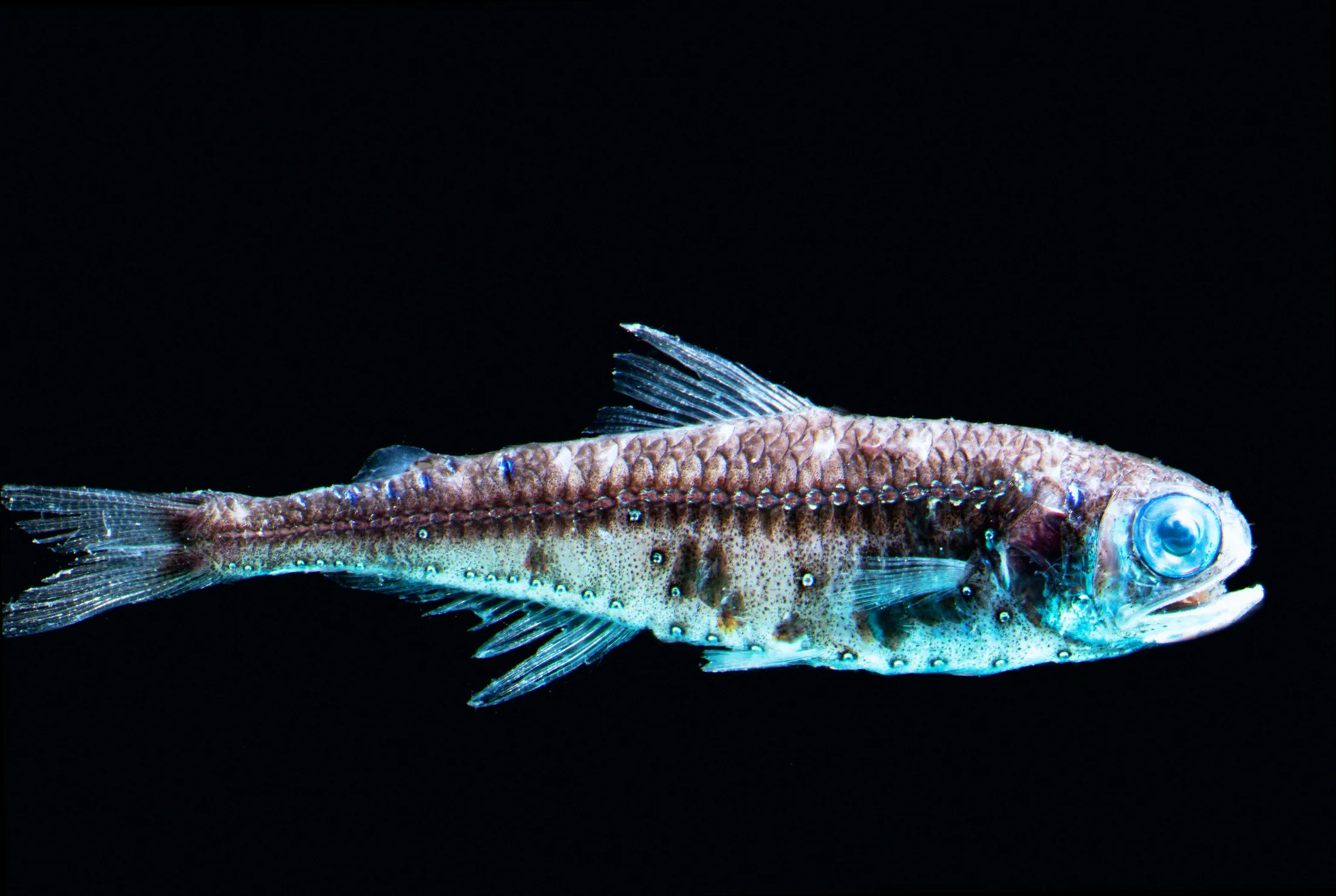
What is Lanternfish bioluminescence and habitat?
Lanternfish, belonging to the family Myctophidae, are a diverse group of small, deep-sea fish characterized by their prominent bioluminescent organs known as photophores. These photophores are typically arranged in species-specific patterns along their bodies, serving functions such as communication, camouflage, and prey attraction. Their habitat is primarily the mesopelagic zone (200-1,000 meters) and the upper bathypelagic zone (1,000-4,000 meters) of all the world's oceans, where they undertake daily vertical migrations to feed in the twilight zone and retreat to deeper, darker waters during the day.
Key Characteristics Overview
| Characteristic | Details |
|---|---|
| Size | Most species range from 2 to 30 centimeters (0.8 to 11.8 inches) in length, with some exceptions. |
| Habitat Depth | Typically inhabit depths between 200 and 1,000 meters (650 to 3,300 feet), with some venturing deeper. |
| Location | Found in all major oceans, from polar to tropical waters, predominantly in the mesopelagic and upper bathypelagic zones. |
| Diet | Carnivorous, feeding on zooplankton, small crustaceans, and other small invertebrates. They are opportunistic feeders. |
Behavior and Adaptations
- Survival mechanisms: Their primary survival mechanism is their bioluminescence, which aids in camouflage through counter-illumination, making them less visible to predators from below. Specialized adaptations include large eyes to detect faint light and a swim bladder for buoyancy control.
- Feeding behavior: Lanternfish are active predators, using their bioluminescence to attract prey or to communicate with others of their species during foraging. They consume a variety of small organisms found in the water column.
- Reproduction: Reproduction typically occurs in warmer, surface waters during specific seasons, with females laying buoyant eggs that drift in the plankton. Larval stages are planktonic before descending to deeper waters as they mature.
- Movement: They are active swimmers, utilizing their fins for propulsion and maneuvering. Their daily vertical migration is a significant behavioral pattern, moving up at night to feed and down during the day to avoid predators.
- Communication: Bioluminescence is a key method of communication. The specific patterns and flashing of photophores are believed to convey information about species identity, mating readiness, and social status.
- Predators and defense: Major predators include larger deep-sea fish, squid, and marine mammals. Their defense strategies include rapid swimming, camouflage via counter-illumination, and the disorienting effect of sudden flashes of light.
Common Misconceptions and Facts
Myth 1: They are dangerous to humans. Fact: Lanternfish are small and pose no threat to humans; they typically inhabit depths far beyond human recreational diving limits and have no interest in human interaction.
Myth 2: They are all giant monsters. Fact: While they are a significant part of the deep-sea ecosystem, the vast majority of lanternfish are small, often no larger than a human hand, and are delicate creatures adapted to extreme conditions.
Myth 3: They can survive in shallow water. Fact: Lanternfish are highly adapted to the high pressure, low temperature, and complete darkness of the deep ocean. Rapid changes in pressure and temperature associated with shallow waters are typically fatal to them.
Frequently Asked Questions (FAQ)
Can Lanternfish bioluminescence and habitat survive in shallow water?
No, lanternfish are exquisitely adapted to the deep ocean and cannot survive in shallow water. The drastic changes in hydrostatic pressure, temperature, and light intensity would be immediately fatal. Their physiology, including specialized swim bladders and enzyme systems, is tuned to the stable, extreme conditions of their natural habitat. Moving them to shallow water would cause their swim bladders to expand, leading to internal damage and death due to decompression sickness-like symptoms.
How does Lanternfish bioluminescence and habitat find food in the deep ocean?
Lanternfish employ several strategies to find food in the deep ocean. Their large eyes are adapted to detect the faint bioluminescent signals of prey. They also actively hunt zooplankton and small crustaceans, often using their own bioluminescence to attract smaller organisms or to illuminate their surroundings briefly. The daily vertical migration is a key feeding strategy, allowing them to exploit the abundant food resources in the upper, twilight zones during the night, before retreating to the safety of the deep during the day.
Is Lanternfish bioluminescence and habitat dangerous to humans?
Lanternfish are not dangerous to humans. They are small, non-aggressive fish that live in the deep sea, far from human interaction. Their primary concern is survival in their challenging environment, which involves avoiding predators and finding food. Encounters between humans and lanternfish are exceedingly rare, and even if they were to occur, these fish pose no physical threat. Their bioluminescence is a natural adaptation for survival, not a weapon.