What is Moon jelly life cycle?
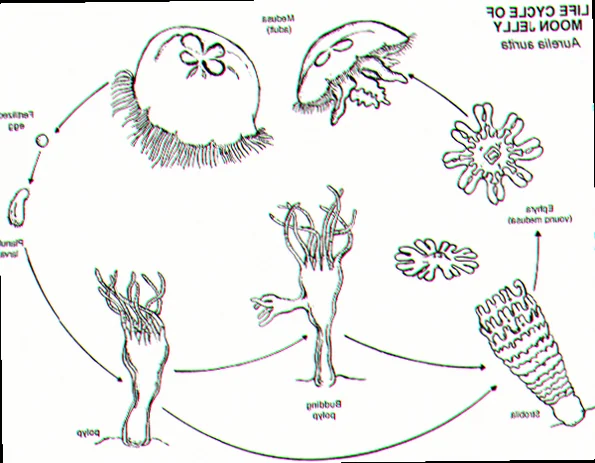
The moon jelly life cycle is a remarkable example of alternation of generations, a strategy where an organism alternates between a sexually reproducing phase and a morphologically distinct asexual phase. It begins with a larval stage called a planula, a tiny, free-swimming, ciliated structure that settles on a suitable substrate. From this settlement, the planula develops into a polyp, a sessile, stalk-like form that reproduces asexually through budding, creating new polyps. Eventually, these polyps metamorphose into medusae, the familiar bell-shaped, free-swimming stage of the jellyfish. Crucially, the medusa then releases eggs and sperm, initiating the sexual reproductive phase, completing the cycle. This entire process can take anywhere from six months to two years, depending on environmental conditions.Key Characteristics Overview
| Characteristic | Details |
|---|---|
| Size | Polyp: 3-10 mm; Medusa: 5-15 cm (diameter) |
| Habitat Depth | Typically 0-100 meters (0-330 feet), but can be found deeper in some regions. |
| Location | Found in temperate and tropical oceans worldwide, including the Atlantic, Pacific, and Indian Oceans. Common in the North Sea, the Mediterranean Sea, and the coasts of North America. |
| Diet | Filter feeders, consuming plankton, including copepods, diatoms, and other small organisms. They use their tentacles to capture food particles suspended in the water. |
Behavior and Adaptations
- Survival mechanisms: Moon jellies possess a simple nervous system, lacking a brain. They rely on a decentralized network of nerves to respond to stimuli. Their gelatinous bodies are largely water, providing buoyancy and reducing the energy required for movement. They also have a rudimentary hydrostatic skeleton, maintained by fluid pressure, which aids in maintaining their bell shape.
- Feeding behavior: The medusa's tentacles are covered in cnidocytes, specialized stinging cells that contain nematocysts - tiny harpoon-like structures that inject venom into prey. When a small organism comes into contact with the tentacles, the nematocysts are triggered, capturing the prey. The jellyfish then draws the prey towards its mouth located on the underside of the bell.
- Reproduction: Reproduction is primarily sexual, occurring when medusae release eggs and sperm into the water column. Fertilization results in the formation of a zygote, which develops into a planula larva. Asexual reproduction (budding) occurs within the polyp stage, creating genetically identical clones.
- Movement: Moon jellies move by pulsating their bell, contracting muscles that cause the bell to contract and then relax, propelling them through the water. They can also drift passively with currents.
- Communication: While not considered a form of complex communication, moon jellies exhibit bioluminescence under certain conditions, though the purpose of this is not fully understood - it may be related to attracting prey or deterring predators.
- Predators and defense: Moon jellies are preyed upon by various animals, including sea turtles, sharks, and some fish. Their primary defense mechanism is their stinging tentacles, which can deliver a painful sting to larger predators. They also have the ability to contract their bell rapidly, releasing water and effectively 'jumping' away from danger.
Common Misconceptions and Facts
Myth 1: They are dangerous to humans. Fact: While moon jelly stings can be painful, they are rarely life-threatening to humans. The venom is not particularly potent, and most stings cause localized pain, redness, and itching. Serious reactions are uncommon.
Myth 2: They are all giant monsters. Fact: Most moon jellies are relatively small, typically only a few centimeters in diameter. The larger specimens are rare and often found in nutrient-rich waters.
Myth 3: They can survive in shallow water. Fact: Moon jellies are adapted to a specific range of hydrostatic pressure. Significant changes in pressure, such as those found in shallow, rapidly fluctuating water environments, can disrupt their internal fluid balance and be fatal.
Frequently Asked Questions (FAQ)
Can Moon jelly life cycle survive in shallow water?
Moon jellies' survival in shallow water is challenging due to significant pressure changes. Their bodies are adapted to the hydrostatic pressure of the open ocean, which decreases with depth. In shallow water, the pressure drops dramatically, causing water to rush into their tissues, disrupting their internal fluid balance and potentially damaging their cells. While some individuals may temporarily tolerate shallow water, prolonged exposure is usually fatal. They require a consistent, stable pressure environment to maintain their physiological functions.
How does Moon jelly life cycle find food in the deep ocean?
Moon jellies are efficient filter feeders, relying on their large surface area to capture plankton. They drift with currents, positioning themselves to maximize their exposure to food particles. Their tentacles, densely covered with nematocysts, efficiently capture small organisms suspended in the water column. The rhythmic pulsing of their bell creates a current that draws water and food particles towards their mouths, ensuring a constant supply of nutrients.
Is Moon jelly life cycle dangerous to humans?
Moon jelly stings are generally not considered dangerous to humans. The venom is relatively mild, and serious reactions are rare. However, individuals with allergies to jellyfish venom may experience more severe symptoms. Most stings cause localized pain, redness, and itching, which typically subside within a few hours. It's important to rinse the affected area with seawater and avoid using fresh water, which can exacerbate the stinging sensation. If you experience severe symptoms, such as difficulty breathing or swelling, seek medical attention immediately.