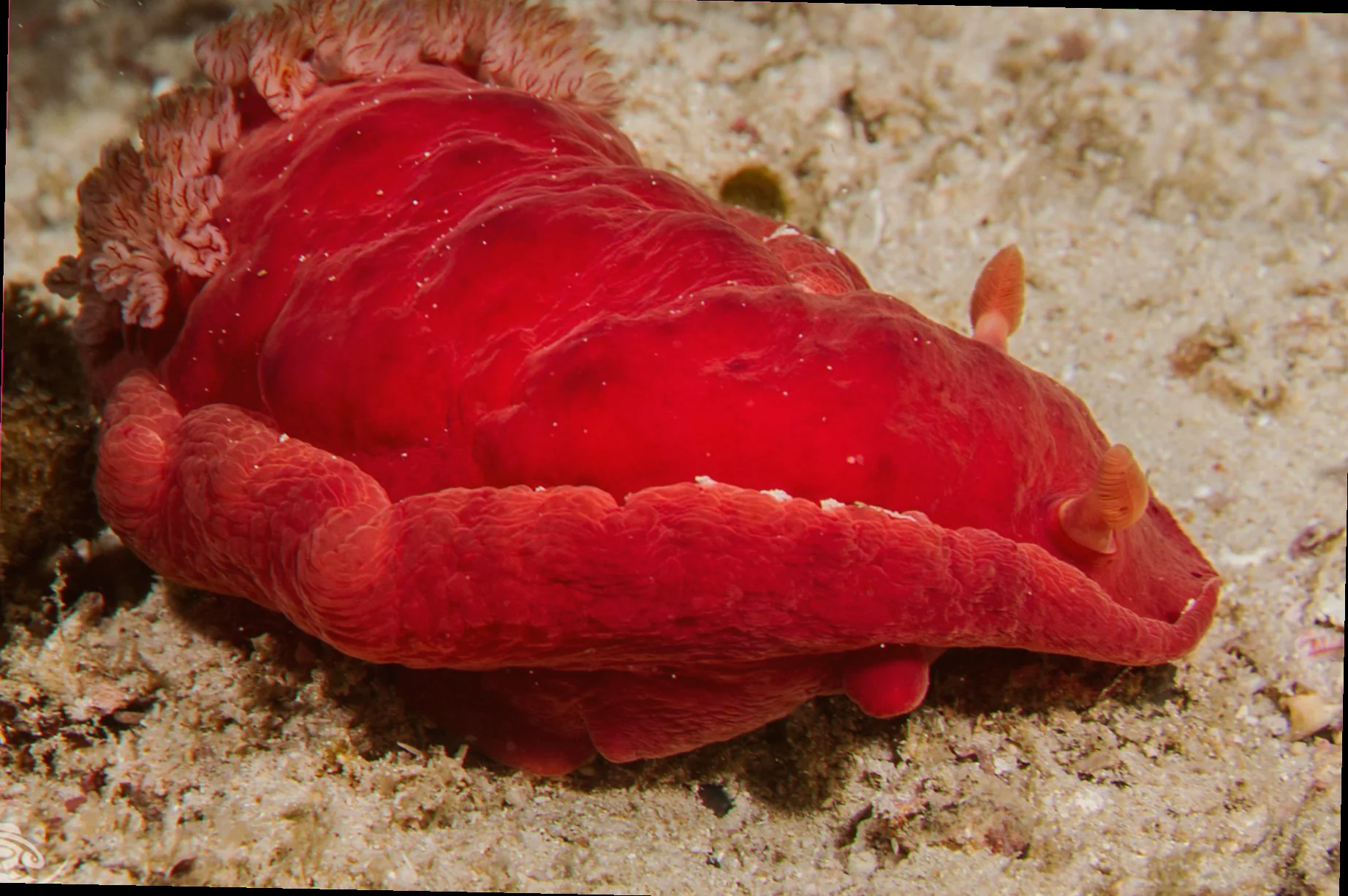
What is Spanish dancer nudibranch?
The Spanish dancer nudibranch, *Hexabranchus sanguineus*, is a large, brightly colored species of sea slug belonging to the order Nudibranchia. These marine gastropod mollusks are characterized by their vivid red or pink bodies adorned with striking white or yellow markings, resembling the flowing skirts of a flamenco dancer. Unlike most nudibranchs, they possess the remarkable ability to swim freely by undulating their bodies, a behavior that gives them their evocative common name.
Key Characteristics Overview
| Characteristic | Details |
|---|---|
| Size | Typically range from 20 to 40 centimeters (8 to 16 inches) in length, with some individuals reaching up to 60 centimeters (24 inches). |
| Habitat Depth | Found from shallow reef flats to depths of approximately 50 meters (165 feet). |
| Location | Widely distributed across the Indo-Pacific region, including the Red Sea, East Africa, the Philippines, Indonesia, and the waters of Australia and the Pacific Islands. |
| Diet | Primarily feed on various species of sponges. They are selective feeders, often targeting specific sponge types. |
Behavior and Adaptations
- Survival mechanisms: Spanish dancers possess a potent defense mechanism derived from the sponges they consume. These sponges often contain toxic compounds, which the nudibranch sequesters within its tissues, making them unpalatable and toxic to potential predators. Their vibrant coloration also serves as an aposematic signal, warning predators of their toxicity.
- Feeding behavior: These nudibranchs are specialized sponge feeders. They use their radula, a ribbon-like tongue covered in tiny teeth, to scrape off and ingest sponge tissue. They are known to be quite deliberate in their feeding, often spending considerable time on a single sponge colony.
- Reproduction: Like most nudibranchs, Spanish dancers are hermaphrodites, meaning each individual possesses both male and female reproductive organs. They engage in reciprocal fertilization, where both individuals in a mating pair fertilize each other. Eggs are typically laid in a gelatinous spiral or ribbon, often attached to the substrate near their food source.
- Movement: While many nudibranchs are slow-moving, the Spanish dancer is an exception. When disturbed or when moving between feeding sites, it can propel itself through the water with graceful, rhythmic undulations of its body and foot, resembling a dancer. This swimming ability is a significant adaptation for escaping predators and covering larger distances.
- Communication: There is no widely documented evidence of Spanish dancer nudibranchs using bioluminescence for communication. Their primary means of interaction is through chemical cues, particularly during mating.
- Predators and defense: Despite their toxicity, Spanish dancers are preyed upon by a limited number of predators that have evolved resistance to their chemical defenses. These can include certain fish and other invertebrates. Their primary defense is their unpalatable nature, coupled with their aposematic coloration and their ability to swim away from danger.
Common Misconceptions and Facts
Myth 1: Spanish dancer nudibranchs are dangerous to humans. Fact: While they contain toxins derived from their diet, these toxins are not harmful to humans through casual contact. The danger is to potential predators. They are not aggressive and pose no threat to divers.
Myth 2: All Spanish dancer nudibranchs are massive. Fact: While *Hexabranchus sanguineus* is one of the larger nudibranch species, many other species of nudibranchs exist, and the vast majority are significantly smaller and more delicate.
Myth 3: Spanish dancer nudibranchs can survive in aquariums without specialized care. Fact: These are highly specialized marine organisms with specific dietary needs (certain sponges) and environmental requirements (water quality, temperature, salinity) that are difficult to replicate in a home aquarium, making them unsuitable for most hobbyists.
Frequently Asked Questions (FAQ)
Can Spanish dancer nudibranch survive in shallow water?
Spanish dancer nudibranchs are typically found in reef environments, which can include shallow waters. However, their preferred habitat is generally between the reef flats and depths of about 50 meters (165 feet). While they can tolerate some variation, significant and rapid changes in depth, pressure, temperature, or salinity can be stressful and potentially fatal. They are adapted to stable marine conditions, and abrupt shifts in their environment are detrimental to their survival.
How does Spanish dancer nudibranch find food in the deep ocean?
Spanish dancer nudibranchs are not typically considered deep-ocean dwellers; they inhabit reef environments. Within their habitat, they locate their food, which are specific types of sponges, primarily through chemoreception. They possess sensory organs that can detect chemical cues released by their prey. Once a sponge is detected, they move towards it to feed. Their visual acuity is generally poor, so chemical sensing is their main method for foraging.
Is Spanish dancer nudibranch dangerous to humans?
No, the Spanish dancer nudibranch is not dangerous to humans. While they accumulate toxins from the sponges they eat to deter predators, these toxins are not readily absorbed or harmful to humans through skin contact. The primary risk would be if a human were to ingest a Spanish dancer, which is highly unlikely and not recommended. They are aposematically colored, meaning their bright colors serve as a warning to potential predators, not as a threat to humans. Encounters with divers are usually passive observations of their beauty.