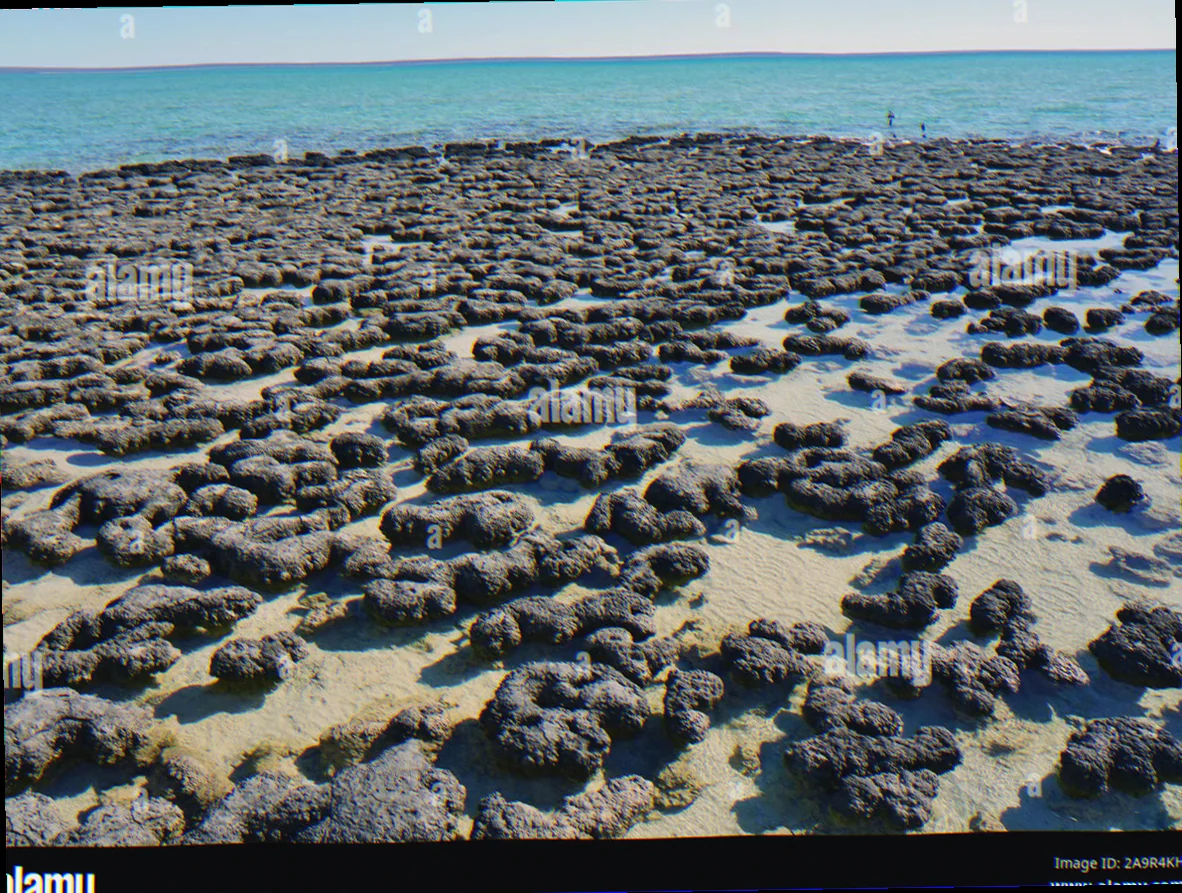
What is Microbial Mats Shark Bay?
Microbial mats are layered structures formed by dense communities of microorganisms, primarily bacteria and archaea, that grow on surfaces in aquatic environments. In Shark Bay, Western Australia, these mats are particularly well-preserved and studied due to the region's hypersaline and arid conditions, which limit the activity of grazing animals that would typically disturb them. These mats are essentially living fossils, offering invaluable insights into the early evolution of life on Earth and the biogeochemical processes that sustain them. They are characterized by distinct layers, each dominated by different microbial groups adapted to specific light, oxygen, and nutrient gradients.
Key Characteristics Overview
| Characteristic | Details |
|---|---|
| Size | Vary widely, from a few millimeters to several centimeters thick, covering vast areas of the seafloor in some locations. |
| Habitat Depth | Primarily found in shallow intertidal and subtidal zones, typically from 0 to 10 meters (0 to 33 feet), though some related communities can exist in deeper waters. |
| Location | Dominantly found in Shark Bay, Western Australia, particularly in Hamelin Pool and other hypersaline embayments. Also found in similar hypersaline or anoxic environments globally. |
| Diet | Autotrophic microorganisms (like cyanobacteria) are primary producers, utilizing sunlight for photosynthesis. Heterotrophic bacteria consume organic matter produced by others or from external sources. |
Behavior and Adaptations
- Survival mechanisms: Microbial mats exhibit remarkable adaptations to survive harsh conditions. Cyanobacteria, key players, have pigments that protect them from intense UV radiation. Many microbes within the mat can enter dormant states to survive desiccation during low tides or periods of extreme salinity. Some employ strategies to bind sediment particles, providing structural integrity against wave action.
- Feeding behavior: The mats are largely self-sustaining ecosystems. Photosynthetic cyanobacteria form the base of the food web, converting sunlight into energy. Other bacteria then decompose dead organic matter, recycle nutrients, and utilize chemical energy from sulfur or iron compounds. This complex interdependency ensures nutrient cycling within the mat.
- Reproduction: Microorganisms reproduce asexually, primarily through binary fission, allowing for rapid population growth when conditions are favorable. Their sheer numbers and efficient reproduction enable them to colonize and maintain these extensive communities.
- Movement: Individual microbial cells within the mat exhibit limited movement, often gliding or drifting within the viscous matrix. The mat itself is largely sessile, anchored to the substrate. However, some motile bacteria can migrate between layers to access optimal conditions.
- Communication: While not in the conventional sense, microbial mats exhibit inter-microbial communication through the release of signaling molecules (quorum sensing). This allows them to coordinate metabolic activities and adapt to environmental changes collectively.
- Predators and defense: In the relatively predator-free hypersaline waters of Shark Bay, microbial mats face fewer direct grazing pressures than in normal marine environments. However, physical disturbances like storms and occasional grazing by specialized invertebrates (e.g., snails) can occur. Their primary defense is their layered structure, chemical defenses, and the rapid growth of their microbial inhabitants.
Common Misconceptions and Facts
Myth 1: Microbial mats are dangerous to humans. Fact: Microbial mats are generally harmless to humans. While they host a diverse array of microorganisms, the risk of encountering pathogenic species in these specific environments is extremely low, and they do not pose a direct threat through contact.
Myth 2: They are all slimy and unattractive. Fact: While some can appear slimy due to their microbial composition and water content, microbial mats can exhibit a range of textures and colors, from earthy browns and greens to vibrant blues and reds, depending on the dominant pigments of the photosynthetic bacteria.
Myth 3: They are only found in Shark Bay. Fact: While Shark Bay is a world-renowned site for studying microbial mats due to their exceptional preservation, similar layered microbial communities are found in various hypersaline, arid, or anoxic environments across the globe, including salt flats, hot springs, and deep-sea hydrothermal vents.
Frequently Asked Questions (FAQ)
Can microbial mats from Shark Bay survive in shallow water?
Microbial mats are highly adapted to their specific environmental conditions, including salinity, temperature, and light levels. While the individual microorganisms that compose a mat might be found in shallow waters, the specific layered structure and community dynamics of a Shark Bay microbial mat are optimized for the hypersaline, arid conditions of its natural habitat. Moving such a mat to a standard shallow marine environment with lower salinity and potentially different grazing pressures would likely disrupt its delicate balance, leading to the demise of the specialized community and the breakdown of the mat's structure. However, the fundamental microbial processes occurring within them are found in many aquatic environments.
How do microbial mats in Shark Bay find food in their environment?
The "feeding" in microbial mats is a complex interplay of autotrophy and heterotrophy. The primary producers are photosynthetic microorganisms, mainly cyanobacteria, which use sunlight to convert carbon dioxide into organic compounds - essentially making their own food. Other bacteria within the mat are heterotrophic, meaning they obtain energy by consuming organic matter produced by other organisms, including dead cells within the mat, or by chemosynthesis, deriving energy from chemical reactions involving compounds like sulfur or iron. This efficient recycling of nutrients within the mat is crucial for its survival in a nutrient-limited environment.
Are microbial mats in Shark Bay dangerous to humans?
Microbial mats in Shark Bay are not dangerous to humans. They are complex communities of bacteria, archaea, and other microorganisms, but the specific species found in these mats do not pose a health risk through casual observation or even brief, accidental contact. The primary "danger" they present is to their own delicate structure if disturbed by human activity, as they are sensitive ecosystems. There are no known instances of microbial mats from Shark Bay causing harm to humans.