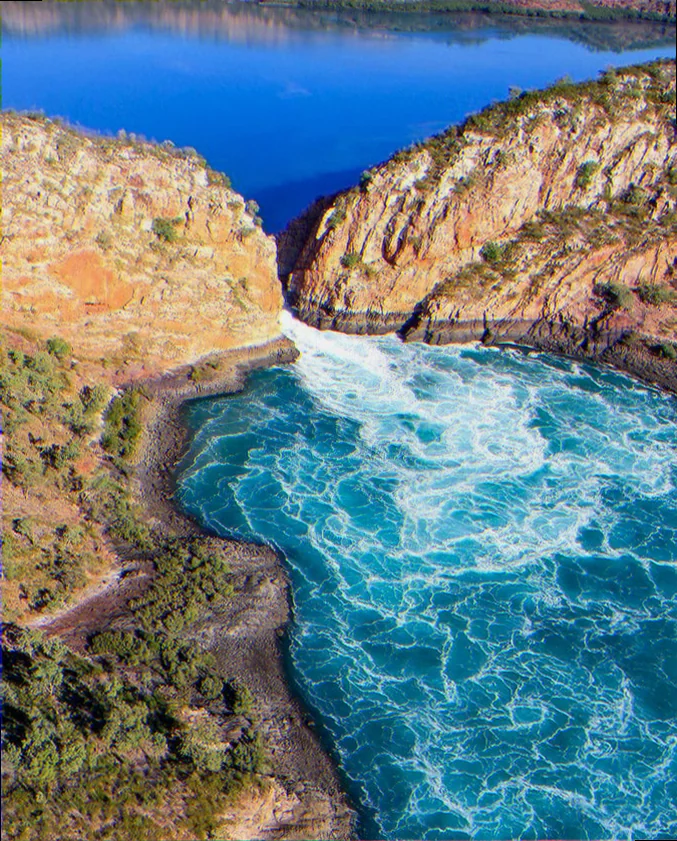
Horizontal falls marine tidal life refers to the unique ecosystem thriving in and around the powerful tidal flows created by the Horizontal Falls in Talbot Bay, Western Australia. These falls aren't waterfalls of freshwater, but rather immense volumes of ocean water forced through narrow gaps between ancient gorges. This creates a highly dynamic environment supporting a diverse range of marine organisms adapted to strong currents, fluctuating salinity, and unique feeding opportunities. Understanding this life requires looking at how species exploit these powerful tides.
What is Horizontal falls marine tidal life?
Horizontal falls marine tidal life encompasses the diverse array of organisms - from microscopic plankton to large predatory fish and marine reptiles - that inhabit the waters surrounding and within the Horizontal Falls in Talbot Bay, Western Australia. The defining characteristic of this ecosystem is its extreme tidal range and the resulting powerful horizontal waterfalls created as tides rush through narrow gorges. These falls generate significant turbulence, upwelling of nutrient-rich water, and a complex hydrodynamic environment that shapes the distribution, behavior, and adaptations of the resident marine life. The constant flow also creates a unique substrate for attachment and filter-feeding organisms.
Key Characteristics Overview
| Characteristic | Details |
|---|---|
| Size | Varies greatly, from plankton (<1mm) to saltwater crocodiles (up to 7m) and large reef fish (up to 2m). |
| Habitat Depth | 0-40 meters (0-131 feet) primarily, influenced by tidal stage and gorge structure. Deeper areas exist outside the immediate falls. |
| Location | Talbot Bay, Kimberley region, Western Australia (14°58′S 123°18′E). Specifically, the gorges of the McLarty Range. |
| Diet | Highly varied; plankton feeders, filter feeders, ambush predators, active hunters, scavengers. Diet is heavily influenced by tidal currents bringing in food sources. |
Behavior and Adaptations
- Survival mechanisms: Many species exhibit strong swimming abilities to navigate the currents. Others, like barnacles and oysters, possess robust attachment mechanisms to withstand the force of the water. Some fish utilize the turbulent water as cover from predators.
- Feeding behavior: Filter feeders (sponges, barnacles) capitalize on the upwelling of nutrient-rich water. Predatory fish (trevally, barracuda) ambush prey carried by the currents. Marine reptiles (saltwater crocodiles) are apex predators, utilizing the falls as hunting grounds.
- Reproduction: Breeding patterns are often synchronized with tidal cycles, maximizing larval dispersal and survival. Many invertebrates release gametes during peak tidal flow. Fish spawning aggregations may occur in calmer eddies.
- Movement: Species demonstrate a range of locomotion methods. Strong swimmers actively navigate the currents, while benthic organisms remain stationary. Plankton are passively transported by the flow.
- Communication: Visual cues are likely important in the turbid water. Some fish may use sound for communication, though this is less studied in this environment.
- Predators and defense: Saltwater crocodiles are the apex predators. Fish are preyed upon by larger fish, sharks, and crocodiles. Invertebrates employ camouflage, shell protection, or rapid burrowing as defense mechanisms.
Common Misconceptions and Facts
Myth 1: The Horizontal Falls are freshwater waterfalls. Fact: They are entirely marine, created by tidal flows forcing saltwater through narrow gorges.
Myth 2: The area is devoid of life due to the strong currents. Fact: The currents *create* a highly productive ecosystem, supporting a diverse range of species.
Myth 3: Only large, powerful animals can survive there. Fact: A wide range of organisms, including delicate invertebrates and plankton, thrive by adapting to the conditions.
Myth 4: The ecosystem is isolated and unchanging. Fact: The Horizontal Falls are connected to the broader Kimberley marine environment, and the ecosystem is dynamic, responding to seasonal changes and weather patterns.
Frequently Asked Questions (FAQ)
Can Horizontal falls marine tidal life survive in shallow water?
Many species within the Horizontal Falls ecosystem are well-adapted to fluctuating water levels and can tolerate shallow water conditions during low tide. However, the rapid changes in salinity and temperature, coupled with increased exposure to predators, present challenges. Species like mud crabs and intertidal snails are specifically adapted to these conditions, possessing physiological mechanisms to cope with desiccation and salinity stress. Fish may seek refuge in deeper pools or move with the tide. The key is the *rate* of change; organisms can handle fluctuations, but rapid shifts can be fatal. The constant tidal flow also prevents stagnation and maintains oxygen levels even in shallow areas.
How does Horizontal falls marine tidal life find food in the deep ocean?
Food acquisition in the Horizontal Falls ecosystem is largely driven by the tidal currents. The strong flows deliver a constant supply of plankton, organic matter, and small fish from surrounding waters. Filter feeders, such as sponges and barnacles, efficiently extract nutrients directly from the water column. Predatory fish employ ambush tactics, utilizing the turbulent water as cover to surprise prey. Saltwater crocodiles are opportunistic hunters, preying on fish, turtles, and even terrestrial animals that venture too close to the water's edge. The upwelling created by the falls also brings nutrient-rich water from deeper layers, fueling primary productivity and supporting the entire food web. Scavengers also benefit from the occasional carcasses carried by the currents.
Is Horizontal falls marine tidal life dangerous to humans?
While the Horizontal Falls ecosystem is fascinating, it does present some potential dangers to humans. Saltwater crocodiles are present and pose a significant threat. Swimming or boating in the area is strongly discouraged due to the risk of crocodile attacks and the powerful currents. Strong tidal flows can easily capsize boats or sweep swimmers away. Jellyfish stings are also a possibility. However, most of the marine life is not directly dangerous to humans. Respecting the environment, following safety guidelines provided by tour operators, and maintaining a safe distance from crocodiles are crucial for a safe experience. The vast majority of marine creatures pose no threat and are best observed from a distance.